
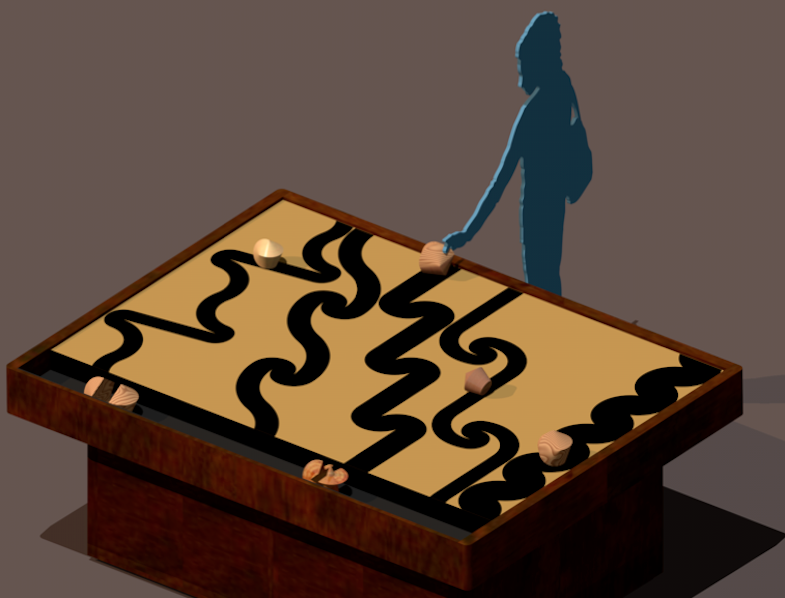
These strange shapes roll on the table following interesting paths. Each shape is made from two parts. Try taking a shape apart and putting it back together differently. How does this change the rolling path of the shape? Can you find a way to make a shape that rolls around in a circle? Can you find a way to make a shape that follows the paths shown on the table?
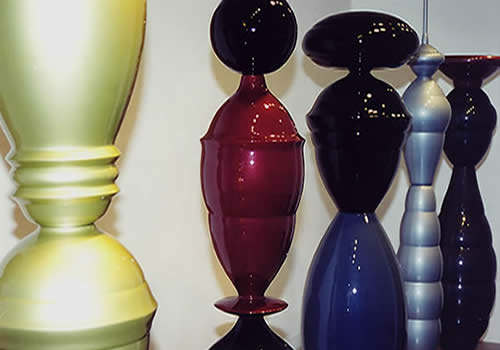
One easy way to create a 3D shape is to take a 2D shape and form a solid of revolution. A solid of revolution is a 3D shape obtained by taking an object and rotating it around a line, keeping track of every position it has passed through. When you take all of those positions together, you get one solid, very symmetric object. For example, you might look at the outline of the pot in the upper picture. As the potter’s wheel rotates, the outline spins to create the 3D pot.
The cross sections of solids of revolution are necessarily circles. Some pretty weird shapes can be made as solid of revolutions, such as the Japanese sculptures in the lower picture. All of the objects at this exhibit are solids of revolution. Can you see what shapes we started with and how we rotated them to make these solids?

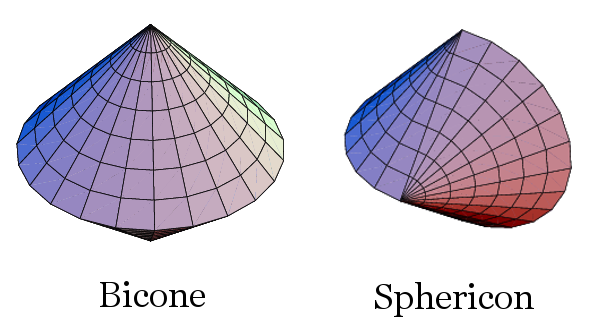
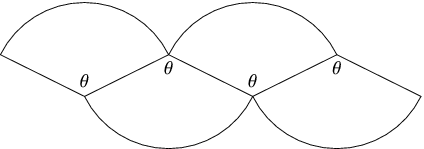
One of the objects featured at Twist ‘N’ Roll is the sphericon. You can picture making it by taking two opposite corners of a square between your fingers and spinning it. The resulting solid is a bicone — two cones that have been glued together at their circular bases. If you then cut the bicone in half so that you recover the square as its cross section, you could rotate one of the pieces 90 degrees and reattach them, giving the sphericon. You can make your own paper sphericon at home using the pattern below. (How big does the angle have to be?) Can you spot the path on the table that looks like this pattern? Try rolling the sphericon along this path!
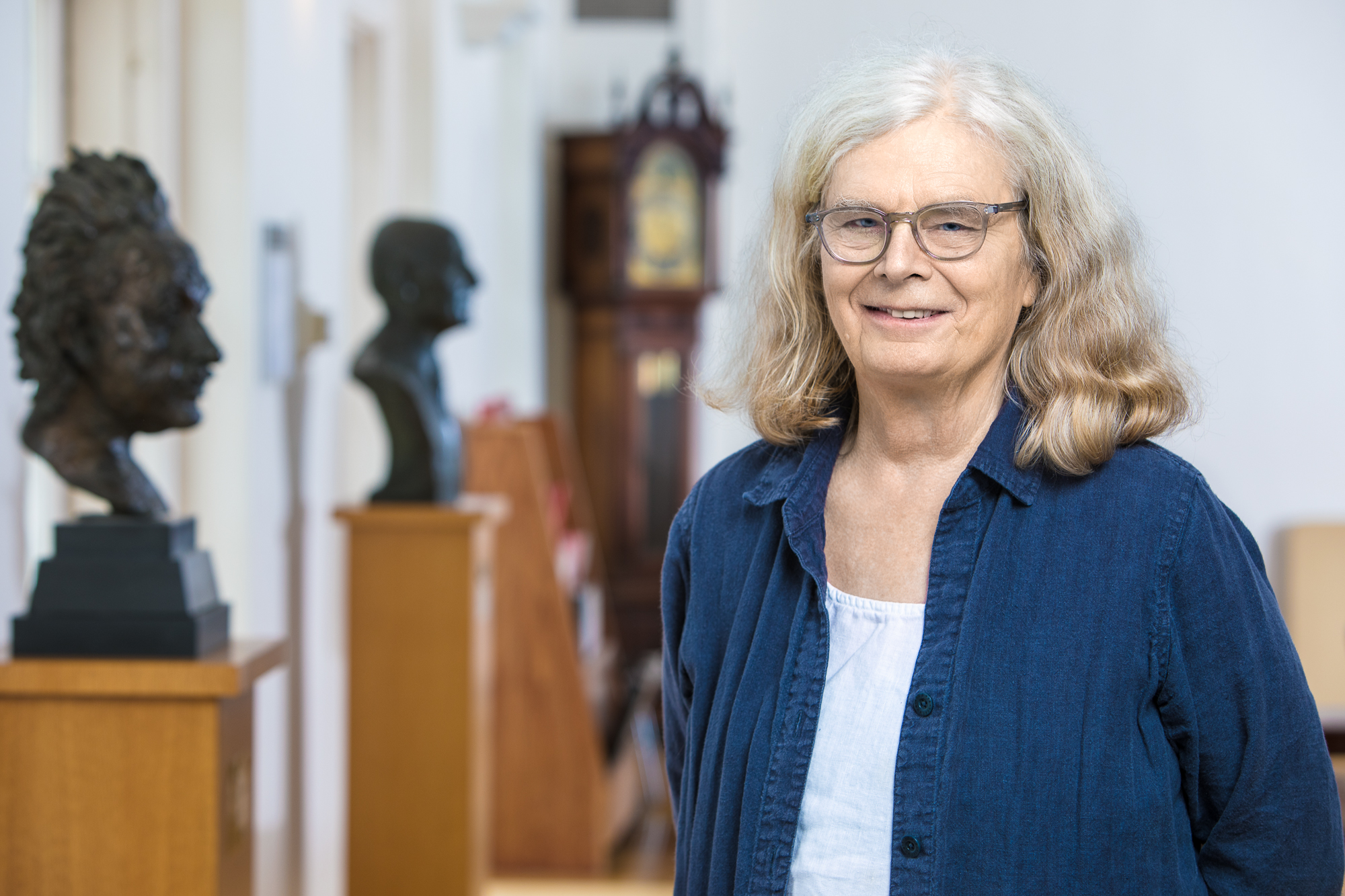
Determining the shape of a solid from seeing its surface unrolled on a table may seem like child’s play, but it’s not so far from the modern mathematical field of geometric analysis. One particular pioneer of the latter is Professor Karen Uhlenbeck, who held the Sid W. Richardson Foundation Regents Chair at the University of Texas at Austin until her retirement. Among her many accolades, Dr. Uhlenbeck is also the first woman to be awarded the nearly $1 million Abel Prize in 2019.