
The shapes in Light Grooves look like they are coming out of the wall, but they have all been made by carving very thin grooves in flat metal plates.
As you walk by the exhibit, millions of glints of light travel along these grooves, and 3D images of mathematical surfaces appear to jump out from the wall. By changing your viewpoint, you can look into and around these images. Or you can animate the entire wall by swinging the lights that illuminate the plates.
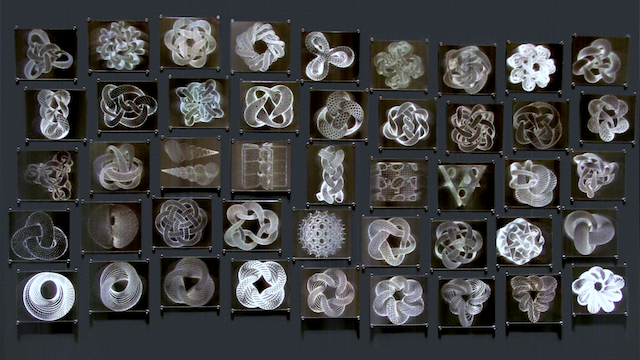
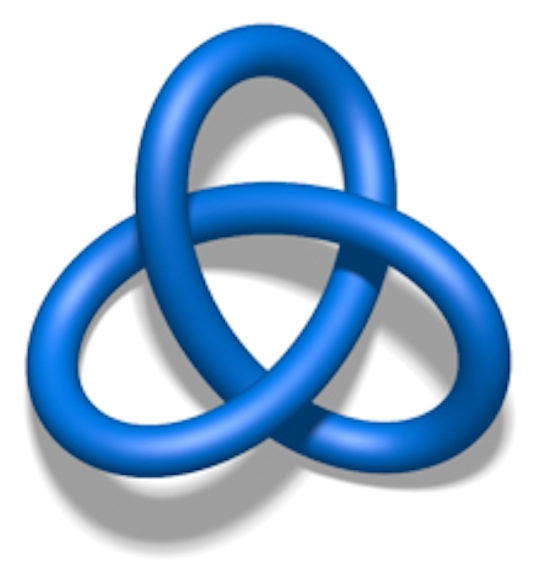
A knot is a closed loop that has been tangled. If it can be untangled without cutting, it is called the unknot.
Telling the difference between knots from unknots is a deep and difficult mathematical problem that has remarkable connections to algebra, sub-atomic physics, molecular biology, and pirates.
Can you tell what is a knot and what is the unknot on the wall?
The shapes carved into the wall were made using a technique called specular holography.
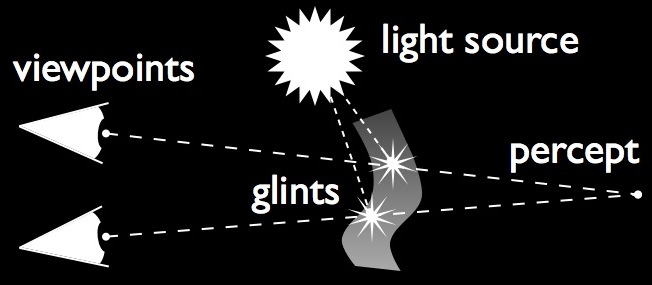
Next time you see a glint of light on a curved surface such as a windshield or a shiny ball, close one eye and then the other. You will notice that each eye sees the glint in a different place. This phenomenon is a key ingredient of 3D perception. Specular holography exploits this phenomenon by shaping a curved surface to place a glint of light in a precise position for each viewpoint. Thousands to millions of these surfaces are combined in a single plate, producing an image of a 3D scene made up of many very small dots. Each surface is precisely and uniquely shaped, yet the grooves are only 1/4 the width of a single human hair!
Specular holography was invented in the early 1990’s by artist Matt Brand, but existed only on paper for 15 years before suitable fabrication technologies became available. Read more about Matt Brand in the People section.
There is more geometry in this exhibit than meets the eye.
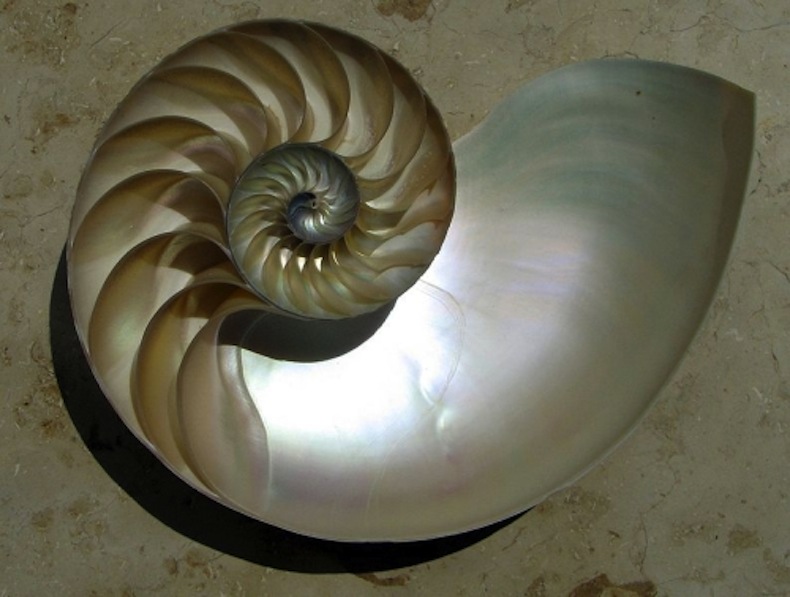
To make sure that the light strikes each plate at roughly the same angle, the plates are tilted to form sections of the same kind of spiral seen in snail shells, pine cones, and sunflowers.
To make it possible to swing the lights without crossing rays of light from adjacent illuminators, the light rays are all carefully aimed so that they are parallel.
The plates are then precisely arranged to create the desired 3-dimensional effect.
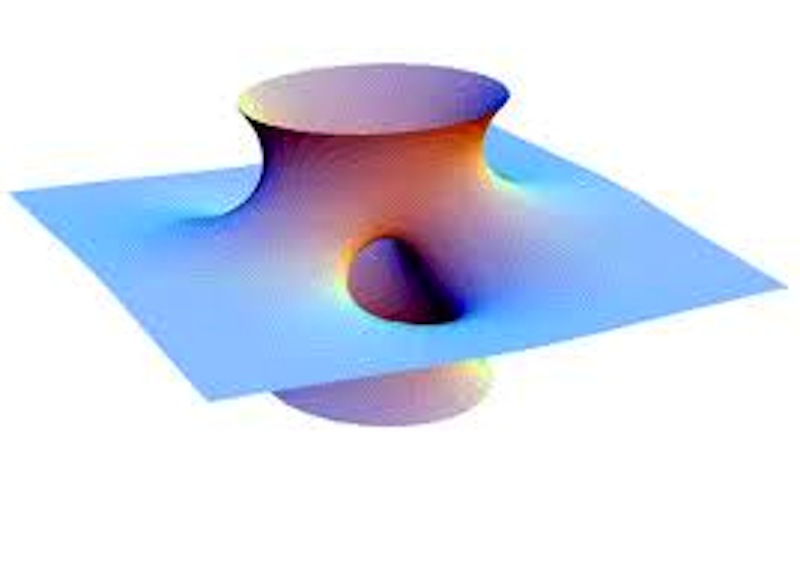
Minimal surfaces are surfaces that, like a stretched rubber sheet or a soap film, reach across their boundaries with minimal surface area. On the wall you see elements of infinite minimal surfaces, which can be extended or repeated and connected infinitely to fill and divide space.
Minimal surfaces that have certain kinds of symmetry are called periodic minimal surfaces. Nature makes extensive use of periodic minimal surfaces at sub-microscopic scales inside the living cell, where they support and organize chemical reactions.
The images in this exhibit were created by Matt Brand, a research scientist and visual artist, using a technique called specular holography.
Dr. Brand was the first person who was able to use this technique to produce distortion-free images. His innovation was to determine how the extremely fine mirrored grooves should be shaped so that the pattern of the reflected light is perceived as solidly three-dimensional.

Beams of light refracting off curved grooves follow the dynamical laws of physics. Dynamical systems, together with ergodic theory and applications to number theory, comprise the research of American mathematician Bryna Kra (b. 1966). Her distinguished career includes serving on the Board of Trustees of the American Mathematical Society as well as becoming a fellow of the American Academy of Arts and Sciences and a member of the National Academy of Sciences.