

The Wall of Fire lights up cross sections of objects that pass through it. A cross section is a shape that would appear if you cut an object all the way through and looked at the cut side.
As you walk through the Wall of Fire, look in the mirror. What are your cross sections?
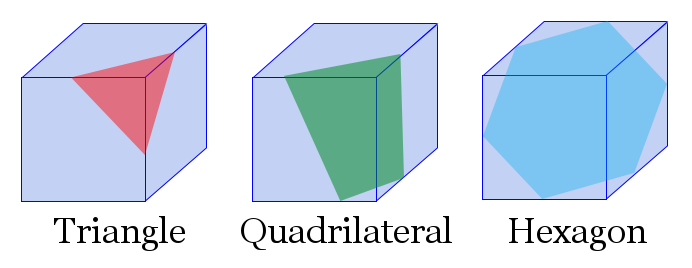
In the figure to the right, you can see triangular, quadrilateral, and hexagonal cross sections of a cube. Can you figure out how to make these by holding the cube in the laser field? What other cross sections can you find?
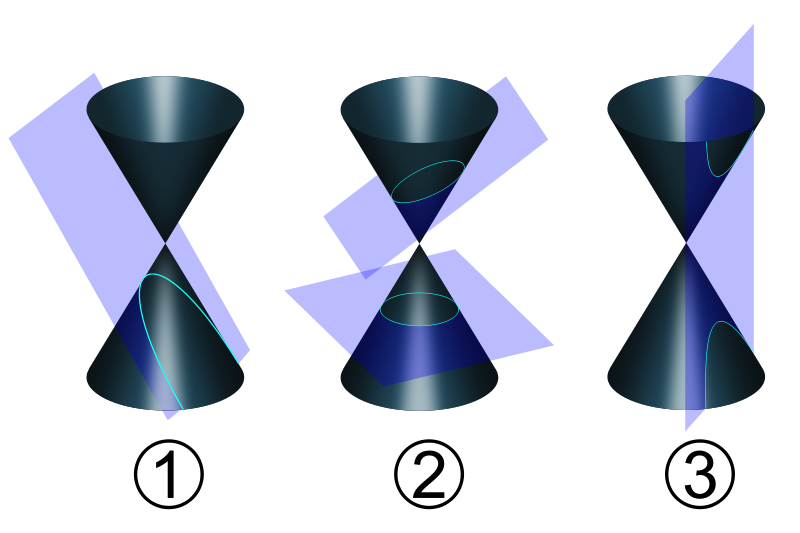
As you pass the cone through the Wall of Fire, see if you can find four different shapes. You may find:
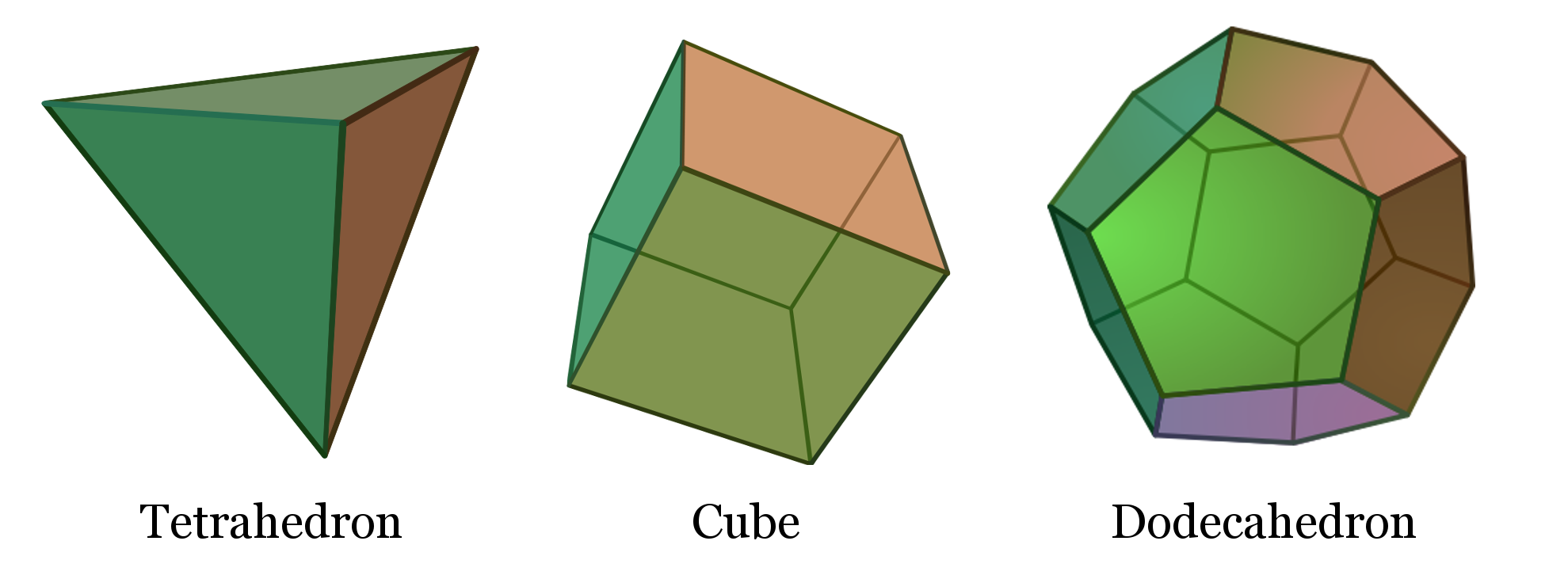
Polygons are 2D shapes that you could cut from paper making only straight cuts, like triangles and squares. Which of the solids have polygonal cross sections? You can find a triangle in the cone and a rectangle in the cylinder, but no other polygons. The other three solids are called polyhedra, which are 3D versions of polygons. Every cross section of a polyhedron is a polygon, so you will be able to find many more types of polygons in them.
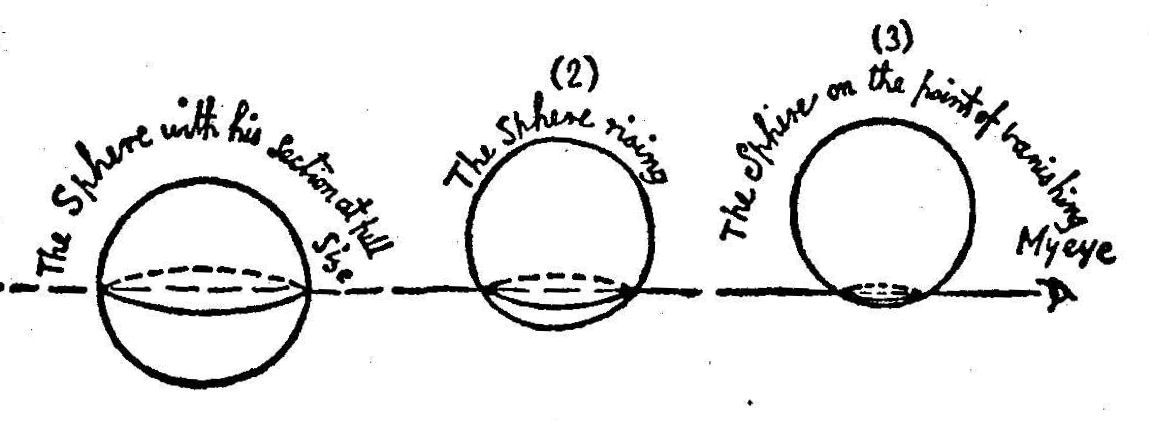
In Flatland: A Romance of Many Dimensions, Edwin Abbott Abbott explores a society that exists in a two-dimensional world. The creatures that inhabit this world are line segments and polygons. One day, A Square meets A Sphere, but since they meet in Flatland, A Square is only able to see cross sections of A Sphere. Having constructed a sphere out of circular cross sections, you might now have a good sense for the circles that A Square saw when A Sphere popped into his world!
If a four-dimensional object were to interact with our three-dimensional world, what would you see? What would happen if a tesseract were to pay us a visit? Just like a cube has squares as its cross-sections, you might see a bunch of cubes as the cross sections of a tesseract. On the other hand, Wall of Fire also highlights other, non-square cross sections of the cube. How else might a tesseract look as it passes through our world?
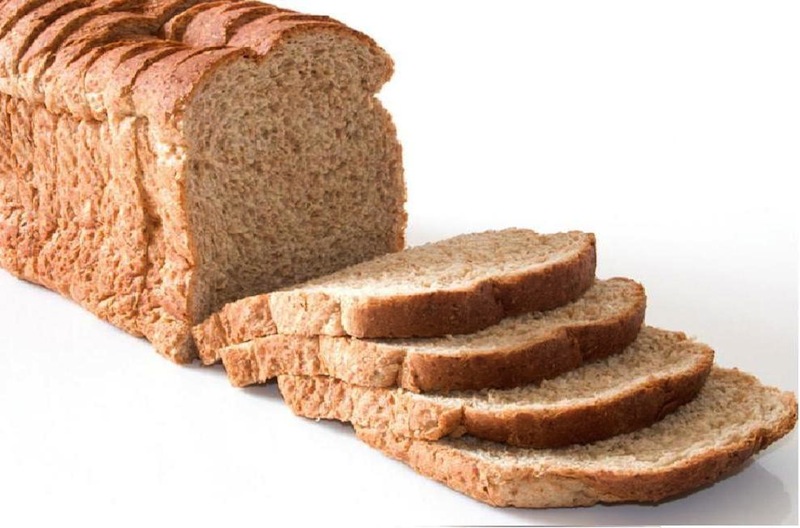
The shape of a slice of bread comes from the shape of the cross section of the loaf.
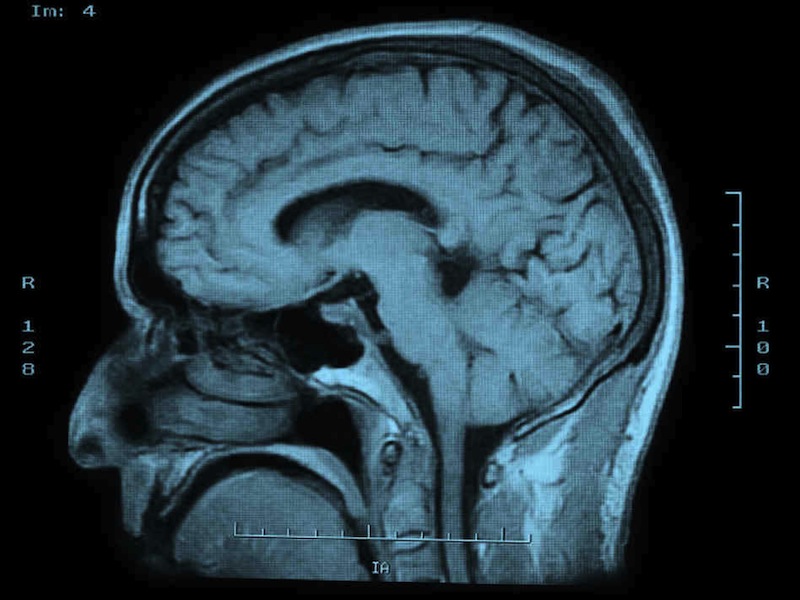
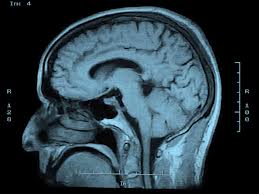
This MRI image shows doctors the cross section of a human brain.
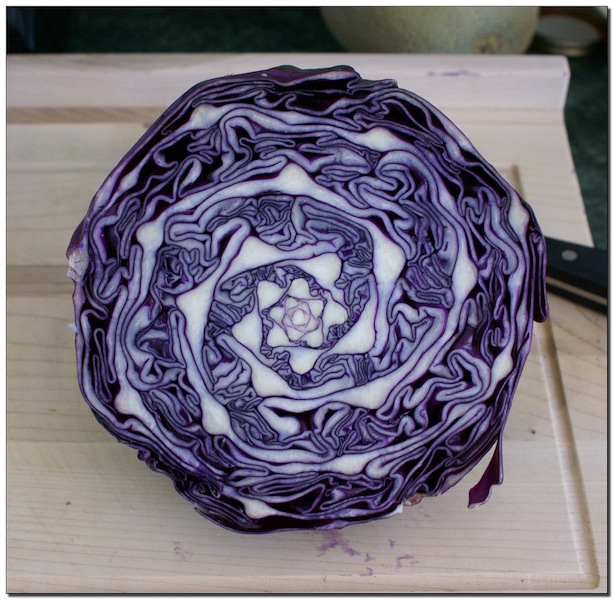
The cross section of this cabbage reveals intricate geometric patterns!
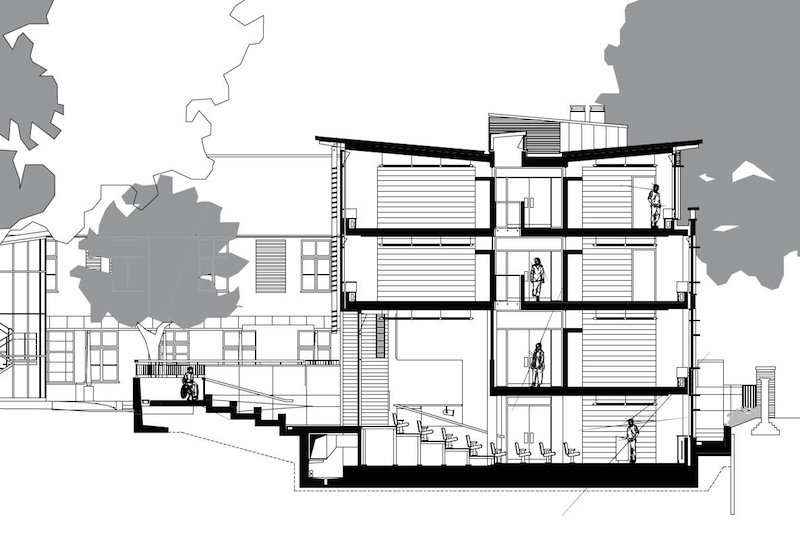
Cross sections are a useful tool for architects, who consider the cross sections of buildings.
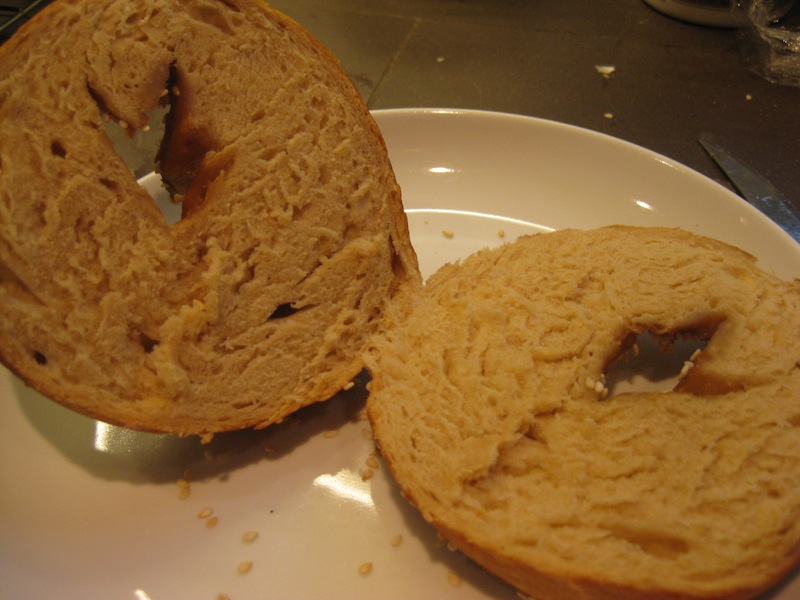
A bagel is in the shape of a torus. This is one cross section of a bagel. What happens when you slice in different directions?
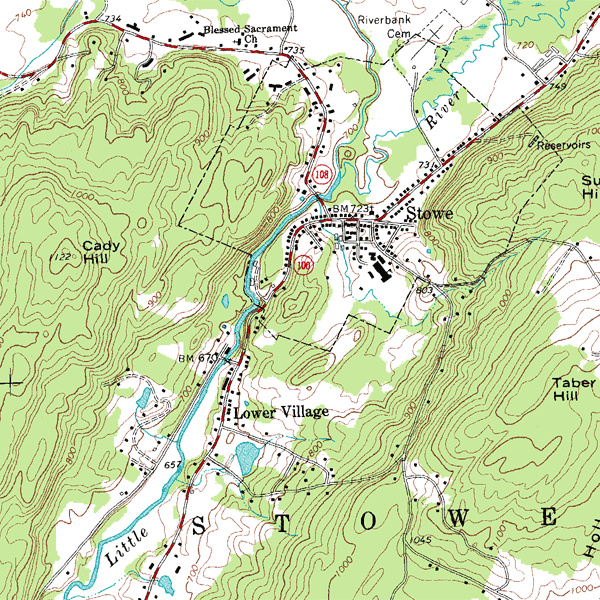
The lines on a topographical map show the shapes of cross sections of the Earth taken at different altitudes.
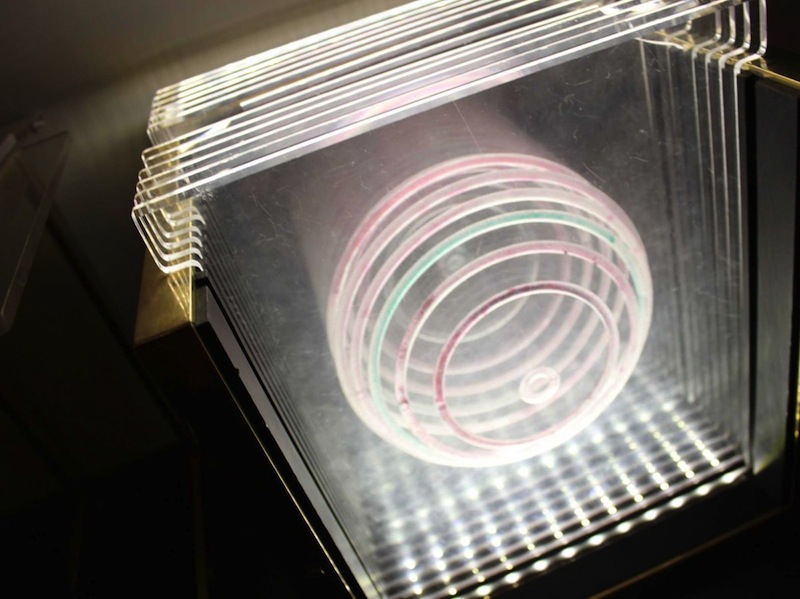
The different cicular cross sections of a sphere are put together at 3-D Doodle to form the sphere.
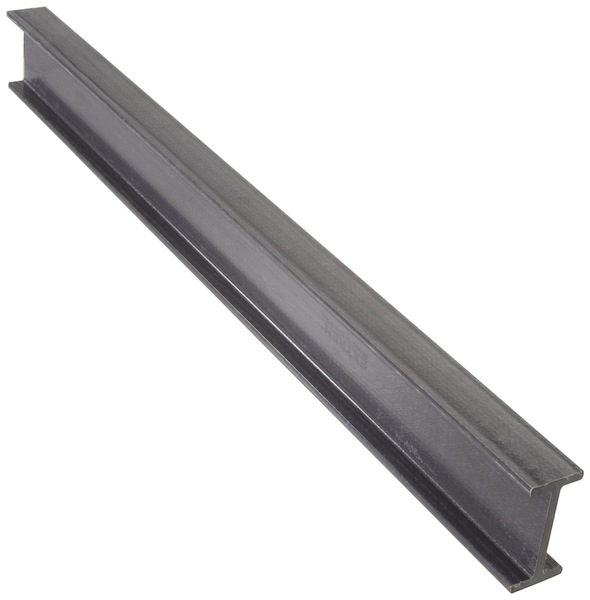
Builders use these beams to give structural support to buildings. They are called I-beams because their cross sections are in the shape of the letter I.

Edwin Abbott Abbott was an English schoolmaster and theologian. Abbott was a well-regarded author, publishing many works on religion, writing, and Francis Bacon. His most famous work, however was Flatland: A Romance of Many Dimensions, a novella he published under the pseudonym A Square.

The James Ax Family Foundation provided support that helped make Wall of Fire possible.
The National Museum of Mathematics thanks Brian Keating for his role in facilitating the sponsorship of the exhibit.
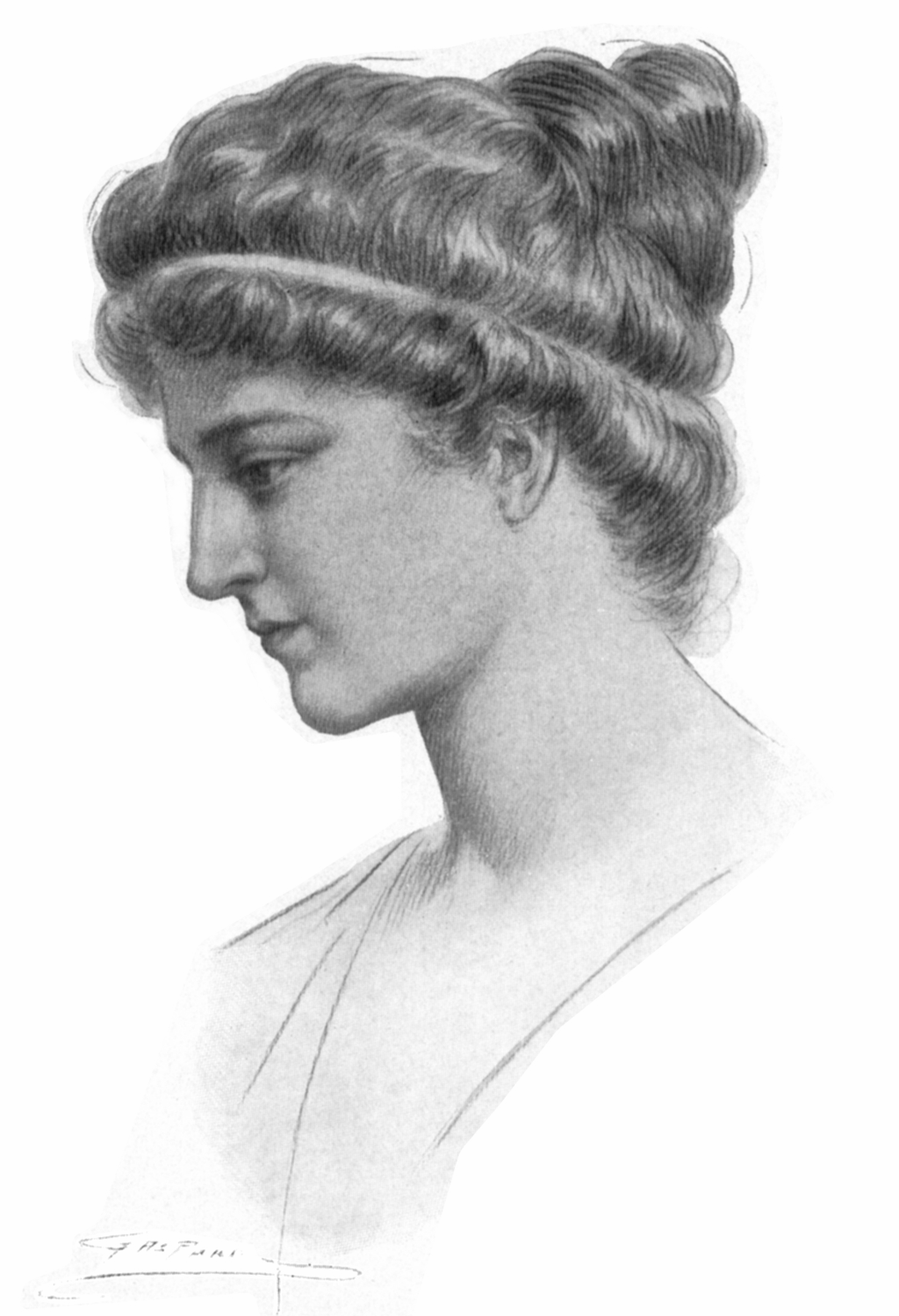
The great Hypatia of Alexandria (c. 360 – 415) wrote important commentaries on many scientific books; she also taught philosophy and astronomy at the famous Library of Alexandria in modern Egypt. Exploring the different cross sections of a cone may not be so far from her studies of the heavens and their motions along conic sections.
Doctors use MRI (Magnetic Resonance Imaging) and CT (Computed Tomography) Scans to look at cross sections of the human body. By examining the cross sections taken at different locations, they can try to understand what is happening inside of their patients without even touching them!
The two pictures on the bottom were produced by a CT scan of the same head. They are both horizontal cross sections, but they look so different! This is because they are cross sections at different heights. Just like how holding different parts of the shapes in Wall of Fire can show very different cross sections.

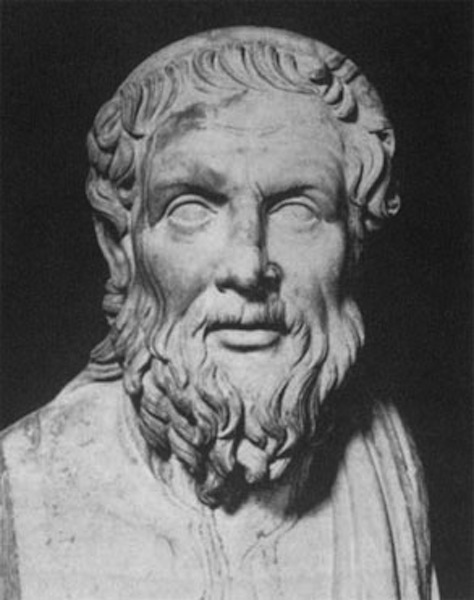
Apollonius of Perga (ca. 260 BCE – ca. 190 BCE) was a Greek mathematician who first named the different conic sections. The names of the curves you see at Wall of Fire as the cross sections of the cone (parabola, ellipse, and hyperbola) come from books written by Apollonius more than 2000 years ago.
He studied the basic characteristics of these curves and discovered many new ones.
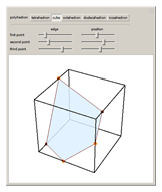
This web application from Wolfram Research allows a user to highlight different cross sections of each of the five Platonic Solids (tetrahedron, cube, octahedron, dodecahedron, and icosahedron).
It is available at: http://demonstrations.wolfram.com/CrossSectionsOfRegularPolyhedra/
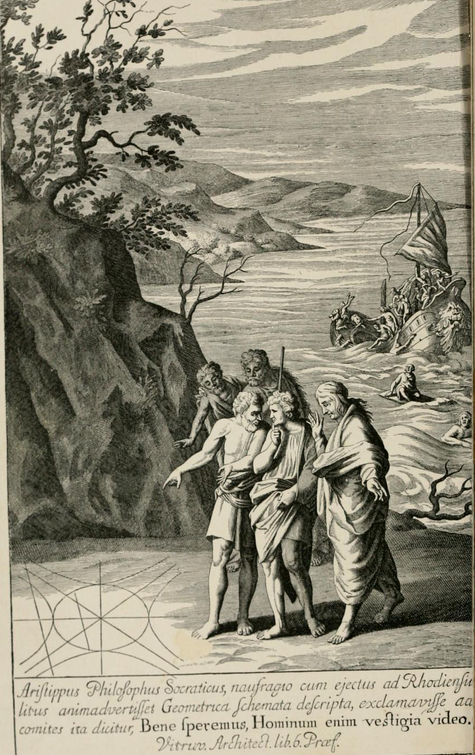
The Treatise on Conics by Apollonius of Perga was a groundbreaking study of the cross sections of a cone, called conic sections, written over 2000 years ago. This work is where the names parabola, ellipse, and hyperbola originate.
It is available to read at:
http://www.archive.org/stream/treatiseonconics00apolrich#page/n9/mode/2up
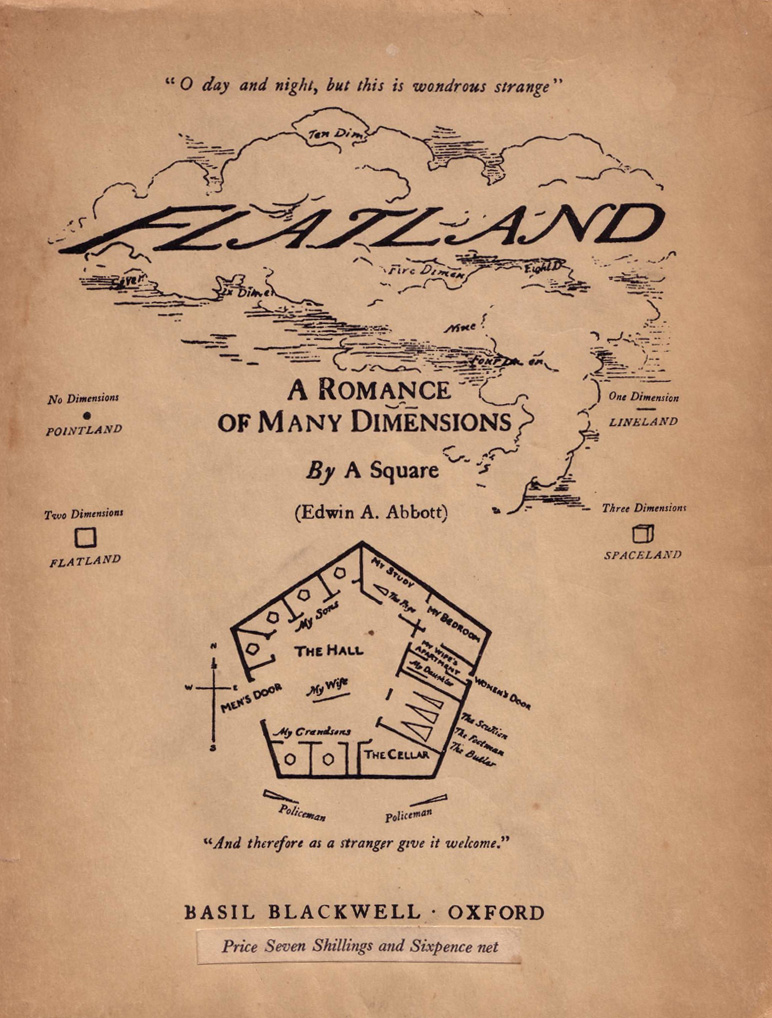
Edwin Abbott Abbott’s Flatland: A Romance of Many Dimensions was written in 1884. Since it is now in the public domain, there are many ways to find and read it online! Here is one link:
https://archive.org/details/flatlandromanceo00abbouoft