

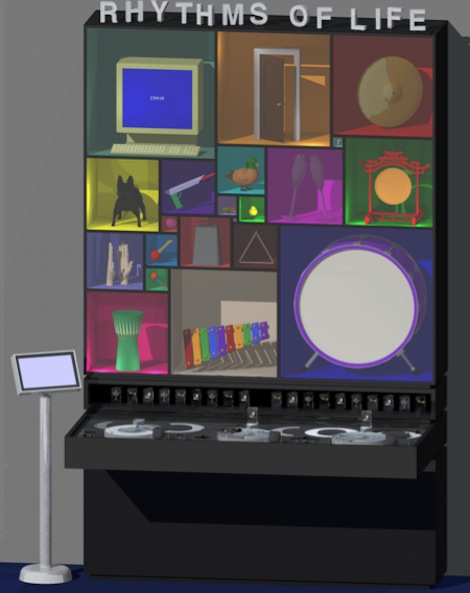
Fit pieces into a wheel to make a complete circle. Choose a sound-selector for the slot. Listen!
Try another set of pieces that make a circle, or change the order of the pieces. Listen!
Listen to each wheel alone, or listen to two or three at once.
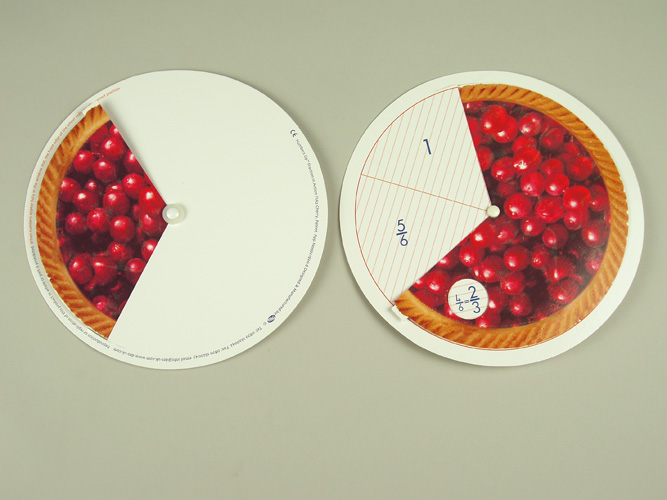
The curved pieces represent different fractions of the whole circle. When it takes exactly 2 same-sized pieces to complete the whole circle, each piece is worth one half, written 1/2, of the circle. What does a wheel sound like in that case?
When it takes 3 same-sized pieces to complete the whole circle, each piece is worth 1/3, or one third. What does a wheel separated into thirds sound like? How many same-sized pieces would you need to have each one be worth 1/6 of the whole circle, and what does that sound like?
It’s fun to mix pieces that are different sizes too. Try mixing two 1/3 pieces and two 1/6 pieces in the same wheel. (You can do it two different ways), alternating or not. Do you like how that rhythm sounds?
Mix pieces to fill each wheel, then listen to the complex rhythms you’ve created. What kinds of rhythms do you like best, and what fractions do they go with?

Since at least the Pythagoreans, mathematicians have been exploring the harmonic (“pleasing”) structure of sound and breaking complicated waves into simpler constituent parts. This analysis took on a new life with the work of Joseph Fourier in the early 19th century, eventually leading to the modern digitization of music, sound, pictures, and video. Today, mathematicians are still very active unraveling the many theoretical mysteries that remain from these initial inquiries. One such mathematician is Professor Jill Pipher (b. 1955) of Brown University, who also served as the President of American Mathematical Society from 2019 to 2021. Dr. Pipher studies interactions of harmonic/Fourier analysis with partial differential equations, as well as farther away topics such as cryptography!

Hannah Lawrence created the violin sound used in Rhythms of Life.

Kevin Lawrence recorded the violin, motorcycle, cowbell, and breaking vase sounds used in Rhythms of Life.
Musicians of all types need to understand what certain rhythms sound like against each other. Drummers and other percussionists especially like to challenge themselves to tap out a certain rhythm with one hand and a different one with the other hand. Can you do that?
The musical notes and rhythms that musicians learn to read on paper correspond to different fractions of the musical measures that are written down, so when you are learning to read music, you are actually learning about fractions too!